
As these are from the earliest post-Flood intervals, it is anticipated that they might differ tremendously in comparison with the biblical timeline. Nothing may even be tens of hundreds of years old, but these ancient samples consistently ‘date’ older than is allowed. This isn’t a problem, as a end result of the dates should be strongly constrained by the amount of carbon-14 in the antediluvian world (i.e., little to none).
broken by radiocarbon decay. Instead, the radiocarbon atoms of their bodies
Since its discovery, carbon-14 testing has had a major impact on our understanding of fields from archaeology to history to geology. Radiocarbon
Carbon-14 dating
Eventually, after 50,000 years or so (or almost 9 half-lives), so little carbon-14 stays that the sample can’t be reliably dated. The Utahraptor Ridge findings have resulted in a succession of papers and shows at nationwide and international conferences. The use of varied radioisotopes permits the relationship of organic and geological samples with a excessive diploma of accuracy. However, radioisotope dating may not work so nicely in the future. Anything that dies after the 1940s, when Nuclear bombs, nuclear reactors and open-air nuclear exams started changing things, will be more durable to date exactly. A few years after the invention of 14C, Willard Libby (a Professor of Chemistry at the University of Chicago) linked the production of atmospheric 14C with vegetation.
One takes borings of trees that died many lots of of years ago and matches them up with at present living timber. Using this system, somebody can bootstrap their means again more than 1,000 years. When Libby did that, he discovered he could accurately determine the age of the piece of wood. An isotope is a form of a component with a certain variety of neutrons, that are the subatomic particles found within the nucleus of an atom that haven’t any cost. While the variety of protons and electrons in an atom determine what element it’s, the variety of neutrons can differ broadly between completely different atoms of the same element.
How radiocarbon forms
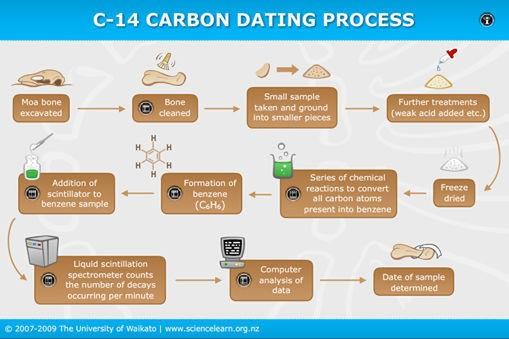
American physicist Willard F. Libby proposed the technique of carbon-14 dating within the mid-1940s and for it received the Nobel Prize for Chemistry in 1960. It has proved to be a flexible strategy of dating archaeological specimens from 500 to 50,000 years previous. There is another reason why pre-Flood remains have outdated carbon dates. It has to do with the dramatic reduction from the excessive antediluvian atmospheric carbon dioxide levels to the trendy value.
No, a dwelling organism cannot be dated with C-14 as the decay begins on demise and the interchange of carbon with the setting is halted. Carbon-14 content in the atmosphere somehow changed over a time frame as a end result of atmospheric results. The atmospheric modifications include volcanic eruptions and the burning of excessive carbon.
The scientists described their findings in a recent problem of the journal Geosciences. Over the timescale of human historical past, possibly somebody turns to their library to study the histories which have been written. From that, they can piece together how way back something occurred. According to the archaeological record, the ancient city of Jericho was destroyed in an unusual way. The walls of the town fell outward, making a slope that an invading army could easily climb (figure 11).
Determining the rate of radiocarbon decay
This is a simple gadget that is attached to an electric circuit. When an ion strikes the inside of the cup, it creates a small electric current. Importantly, the present is solely based mostly on the cost, and has nothing to do with mass. The circuit should be extremely sensitive and very correct, for even when a number of billions of ions are putting the detector per second, the present will solely be about one nanoamp. An ampere is outlined as a present of 1 coulomb of electric cost per second, and a coulomb is 6.241 × 10¹⁸ electric expenses.
Radiocarbon dating, also called carbon-14 dating, is a method to determine the age of natural materials as outdated as 60,000 years. To understand why, one wants to know the concept of a half-life. This is simply the period of time it takes for ½ of a radioactive material to break down. If the earth had been an enormous ball of pure carbon-14, after just one half-life (5,700 ± 30 years) fully one-half of all of the atoms would have already decayed (into nitrogen-14 atoms). For solutions to different radiometric dating methods, see our Radiometric Dating Questions and Answers web page. The growing importance of our cities and cities uses they are now a subjectThe initials BP or bp and rarely B.
Radiocarbon dating
is alive, it replaces any carbon molecule that has decayed into nitrogen. If we all know what fraction of the carbon atoms are radioactive, we will also calculate
It assumes that influx of cosmic rays into the environment has always